
Opinion: Sri Lanka’s Current Nutrition Challenges – How Can They Be Addressed?
By Dr Pulasthi Amarasinghe
- Sri Lanka is reaching a critical point as a result of poor access to affordable, nutritious food. Nutritional security has taken a backseat to simply meeting basic calorie requirements.
- The nutritional landscape can significantly improve through shifts in tobacco and alcohol expenditure to food without solely relying on major macroeconomic transformations.
- Appropriate fiscal policies and regulations should be a key focus for candidates in the upcoming elections to make nutritious diets affordable, accessible, and desirable for the poor and vulnerable communities.
In the face of recent crises that have undone long-term development gains, nutrition and its related health problems are major concerns for Sri Lanka. The economic downturn following the COVID-19 pandemic, inflation, and supply chain disruptions have exacerbated food and nutrition problems. It has led to a rise in food prices and income losses that significantly constrained the population’s ability to afford a nutritious diet.
The Household Survey of the Department of Census and Statistics (DCS) on the Impact of Economic Crisis 2023 revealed that over 90% of households experienced increased monthly expenditures, with food inflation being the primary cause. The impact is particularly severe for the poorest and most vulnerable communities, especially in the rural and estate sectors and female-headed households. The prevalence of stunting, wasting, and underweight children under five years of age has increased post-pandemic, highlighting long-term health issues.
Amidst macroeconomic uncertainty, less explored approaches, such as shifting away from adverse health behaviours such as smoking and drinking, can create additional space for expenditures to shift toward nutritional needs. It provides a mechanism to improve and diversify diets without relying on significant economic structural transformations in the country. With the upcoming general elections, the voters and policymakers should understand nutritional problems in the country and recognise the crucial role of policy changes, regulations, and advocacy in overcoming nutritional challenges.
An Overview of Access to Food and Nutrition
Nutrition security is no longer a primary concern in the face of increased food insecurity, with households and government policies targeting increased energy intake at the cost of meeting nutrient requirements. The IPS’ Sri Lanka: State of the Economy 2024 report finds that households have struggled to maintain a balanced diet, often undergoing a shift in meal composition across rural and urban households, that sacrifices nutrition for quantity. For instance, protein sources such as meat, fish, and eggs have become prohibitively expensive for many families. In response to these challenges, households have employed various coping strategies to manage their limited resources.
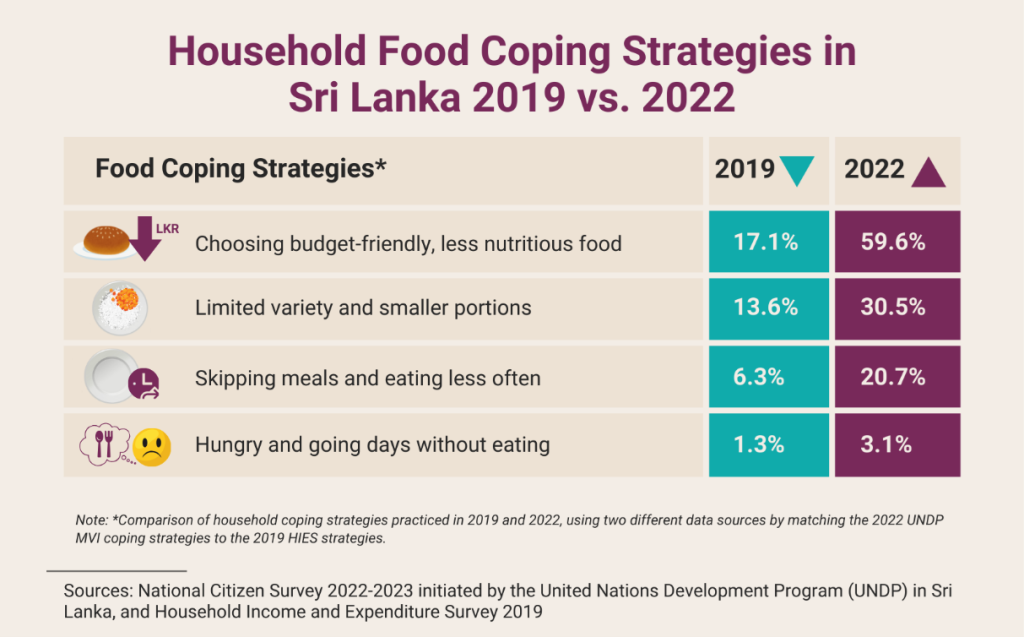
These include reducing the number of meals per day, limiting the consumption of adults to ensure children have enough to eat, and skipping meals altogether. Figure 1 indicates that 59.6% of households relied on less preferred and cheaper food options in 2022, up from 17.1% in 2019. This shift highlights how economic hardships have pushed families toward a more calorie-centric diet at the expense of macro and micronutrient intake.
Figure 1: Percentage (Share of Households) of Food Coping Strategies Uptake by Households in Sri Lanka 2019 vs 2022
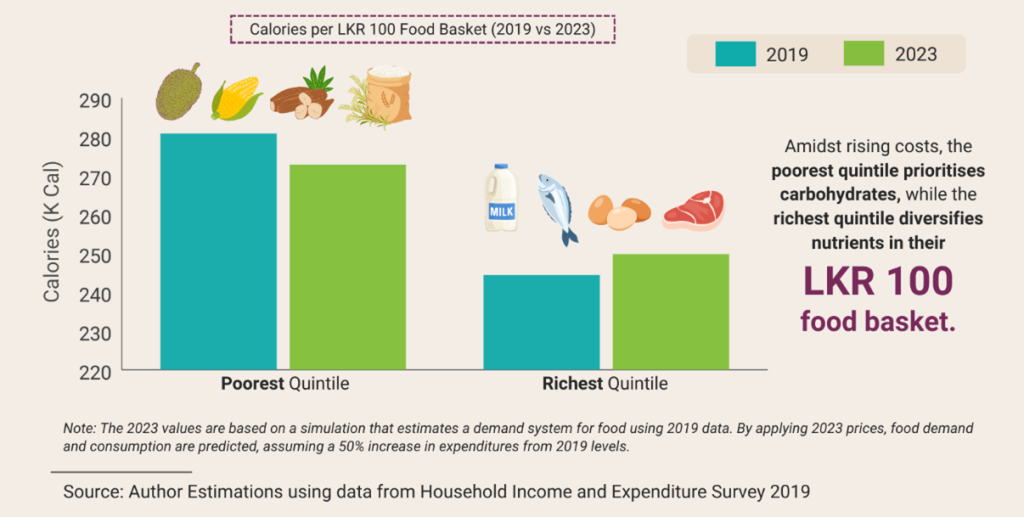
The caloric yield from food items per LKR 100 has also decreased significantly, with rice, dhal, and wheat flour showing more than a 50% reduction in caloric yield from 2019 to 2023. The cost-effectiveness of households is likely to be affected as well, meaning that households are unlikely to receive the same value they previously got from LKR 100 worth of food and are constrained in their ability to be cost-effective. While the cost-effective capacities of the poorest quintiles are historically relatively high compared to the wealthiest quintile, the economic crisis has worsened such capabilities of the poor while forcing even the richest quintiles to become more cost-efficient than before.
Figure 2: Household Calorie Consumption in a Food Basket Worth LKR 100
Prioritising Nutrition Through Shifts in Expenditures
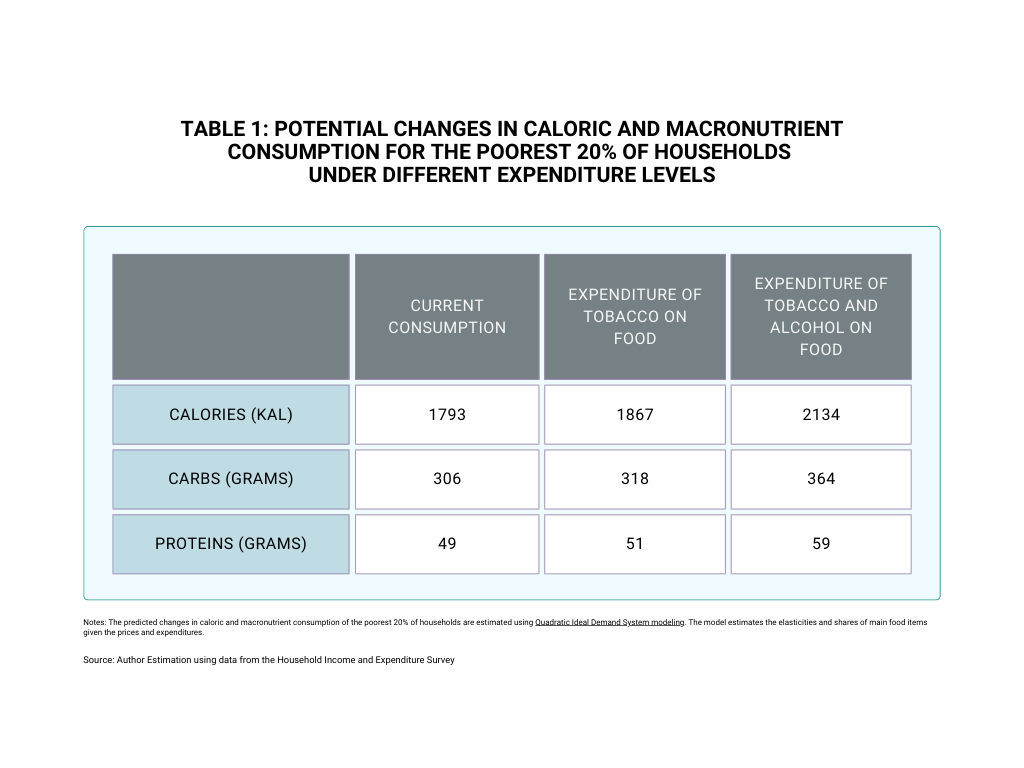
Reducing tobacco and alcohol expenditure for nutritional gains, among other measures, is far-reaching as it benefits health through many channels. As Table 1 shows, improving food and nutritional security in Sri Lanka lies in addressing the non-food expenditure of low-income households, particularly on items like tobacco and alcohol. A demand system analysis of major food items suggests that reallocating expenditures from smoking and alcohol to food could substantially improve caloric and nutrient intake. For instance, for the poorest 20% of households, reallocating tobacco expenditures toward food could increase the daily caloric intake by approximately 4.2%, while redirecting both tobacco and alcohol expenditures could lead to a 19.1% increase.
This shift would increase caloric intake and improve macronutrient intake, including proteins and fats, which are critical for overall health. Proteins from food items like meat, fish, and eggs, which have become less accessible due to rising costs, could become more available if tobacco and alcohol expenditures were redirected. The estimated increase in daily caloric intake for the poorest households could rise from 1,792 kilocalories (kcal) to 2,134 kcal if they reallocate tobacco and alcohol expenses to food. Those caloric gains could address the energy requirements considered first-order issues, while predicted improved variety and quality would also address nutritional security.
Table 1: Potential Changes in Caloric and Macronutrient Consumption for the Poorest 20% of Households under Different Expenditure Levels
Source: Author Estimation using data from the Household Income and Expenditure Survey